Macroeconomics
Improved FOMC Outlook
The people who determine monetary policy in the US report their forecasts for key economic indicators. The group’s December forecast was released yesterday and shows an improved outlook.
At least eight times a year, the Federal Reserve board members and regional bank presidents who are members of the Federal Open Market Committee (FOMC) meet for two days in Washington, D.C. to discuss and vote on monetary policy. In conjunction with these meetings, members report their forecast for the outlook of the US economy. Specifically, members report projections for GDP, unemployment, and inflation. Each quarter, the Fed releases a summary of these projections, in what has become a closely watched report.
The actual data, March 2023 projections, and December 2023 projections are summarized in the following charts. In each case, the actual data is significantly improved over the March 2023 projection. Real GDP is higher than previously forecast, and unemployment and inflation rates are lower.
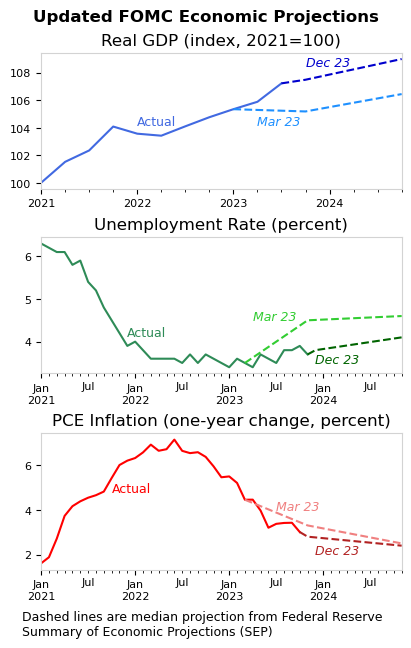
Reflecting improved economic conditions, the December projections, released yesterday, show a far more positive outlook than was expected in March. In March, one-year GDP growth for 2023 was projected to be a meager 0.4 percent; the December projection shows growth of 2.6 percent. Likewise, the unemployment rate was forecast to rise to 4.5 percent in 2023 Q4, but has not, and is now projected to average 3.8 percent in Q4. Further, PCE inflation is below the March forecast of 3.3 percent and is now expected grow by 2.8 percent this year.
While the FOMC left monetary policy unchanged in the December meeting, the projection materials show lower interest rates in 2024. In essence, improvements to the actual economy have taken pressure off of the Fed. Pending any major disruption, the FOMC can now pivot their focus from stopping inflation toward finding and maintaining neutral monetary policy.