MacroeconomicsWages & Income
Who Benefits from a Jobless Boom?
US economic output is booming despite very weak job growth. By definition, this means existing workers are producing more. Many workers, however, are not getting more.
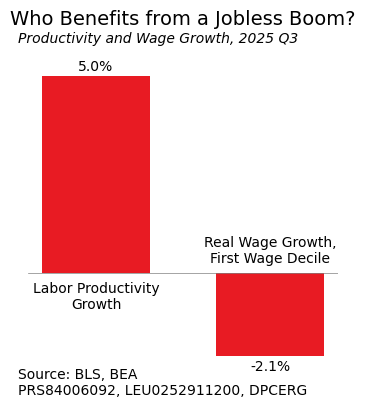
In the latest data, the inflation-adjusted output of US businesses increased at an annual rate of 5.5 percent in 2025 Q3. In the same period, total hours worked increased by only 0.5 percent, meaning workers produced five percent more during each hour worked (chart 1).
Labor productivity growth of five percent is rare. Productivity growth averages less than two percent since 2015. Yet Q3 is not necessarily an anomaly. Productivity seems to be booming. In Q2, productivity grew by 4.4 percent. Projections for Q4 are likewise strong. Productivity has grown by 2.6 percent per year since 2023.
A more-productive workforce can be paid higher wages without causing inflation. This is an incredibly important point. Indeed, when workers are in a strong bargaining position and productivity is booming, workers have historically benefited.
The latest data, however, shows low-wage workers falling rapidly behind. In 2025 Q3, the first decile worker is paid $616 per week, an increase of $1 from Q2, but a decrease of $3 from Q1. Consumer prices increased much faster than pay for these workers. Inflation-adjusted wages fell at an annual rate of 2.1 percent in Q3 (chart 1), following an astounding annualized drop of 4.6 percent in Q2.
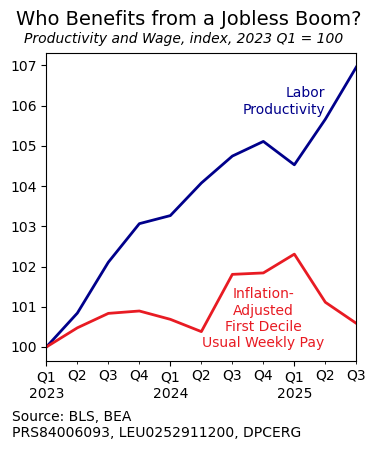
The divergence in productivity and pay is a long-standing issue. Recently, the gap has been widening for low-wage workers (chart 2). Since 2023, workers are producing about seven percent more per hour for businesses. Yet low-wage workers received less than one percent more in earnings, in total over the nearly three-year period.
It will be worth watching these data over the next few quarters to see if recent trends continue.