Data & PythonTrade & International
Dollar-indices: hitting recent lows (and how to plot with Python)
While the dollar has depreciated against most major currencies over the past month (notably 4.4% against the Canadian dollar, 3.3% against the Yen, 4.2% against the Real, and 8.6% against the Rand), the Fed H.10 release provides measures of exactly how much the value of the greenback has fallen relative to a weighted set of its trading partners. The latest data show that the U.S. dollar has fallen on April 12 to its lowest level since June 2015 compared to other major currencies, and its lowest level since October 2015 compared to a broad index of currencies.
This post covers the trade-weighted dollar and is split into two segments: a description of the index and its recent behavior, and a short python script showing how you can use the pandas and matplotlib libraries to retrieve the time series and plot it.
Two trade-weighted dollar indices, described
The Fed’s two most common trade-weighted indices of the foreign exchange value of the U.S. dollar are the major-currencies index and the broad-index. Both measure the value of the dollar relative to other countries’ currencies and intend to be aligned, through their weighting system, with the currencies closely related to U.S. trade patterns. The broad index, however, covers more currencies, and especially more emerging market currencies.
Discrepancies between even the broad index and the way the dollar is actually traded are inevitable. For example, the broad index weight in 2016 for Canada is 12.664 percent (broad index weights are updated yearly), whereas year-t0-date, 15.2 percent of total U.S. trade has been with Canada. From a share-of-total-U.S.-trade perspective, the broad index is somewhat overweight the Yuan, Euro, and Yen, and underweight the Canadian dollar and Mexican peso.
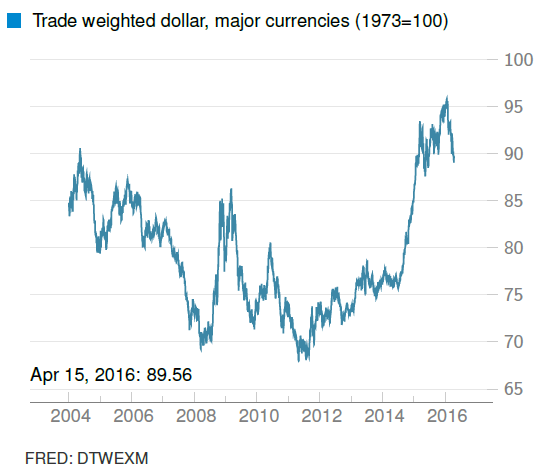 The major currencies index contains fewer currencies than the broad index, and has fallen to a 22-month low. (plot from [dashboard](/chartbook.html))
From 2005 through 2015, the major currencies index remained largely within a range of 70-85. After a steep climb through 2015, in January, the measure peaked at 95.8, to the frustration of U.S. exporters whose customers essentially pay more for the same goods (and as a result buy fewer). On April 12, the major currencies index hit its lowest level since June 2015.
Meanwhile, the broad index has moved in the same direction, hitting a five month low on April 12. The plot of the broad index is below, including how to obtain it. You can substitute DTWEXB with DTWEXM if you are interested in the major currencies index.
Python: Retrieve and plot the trade-weighted dollar
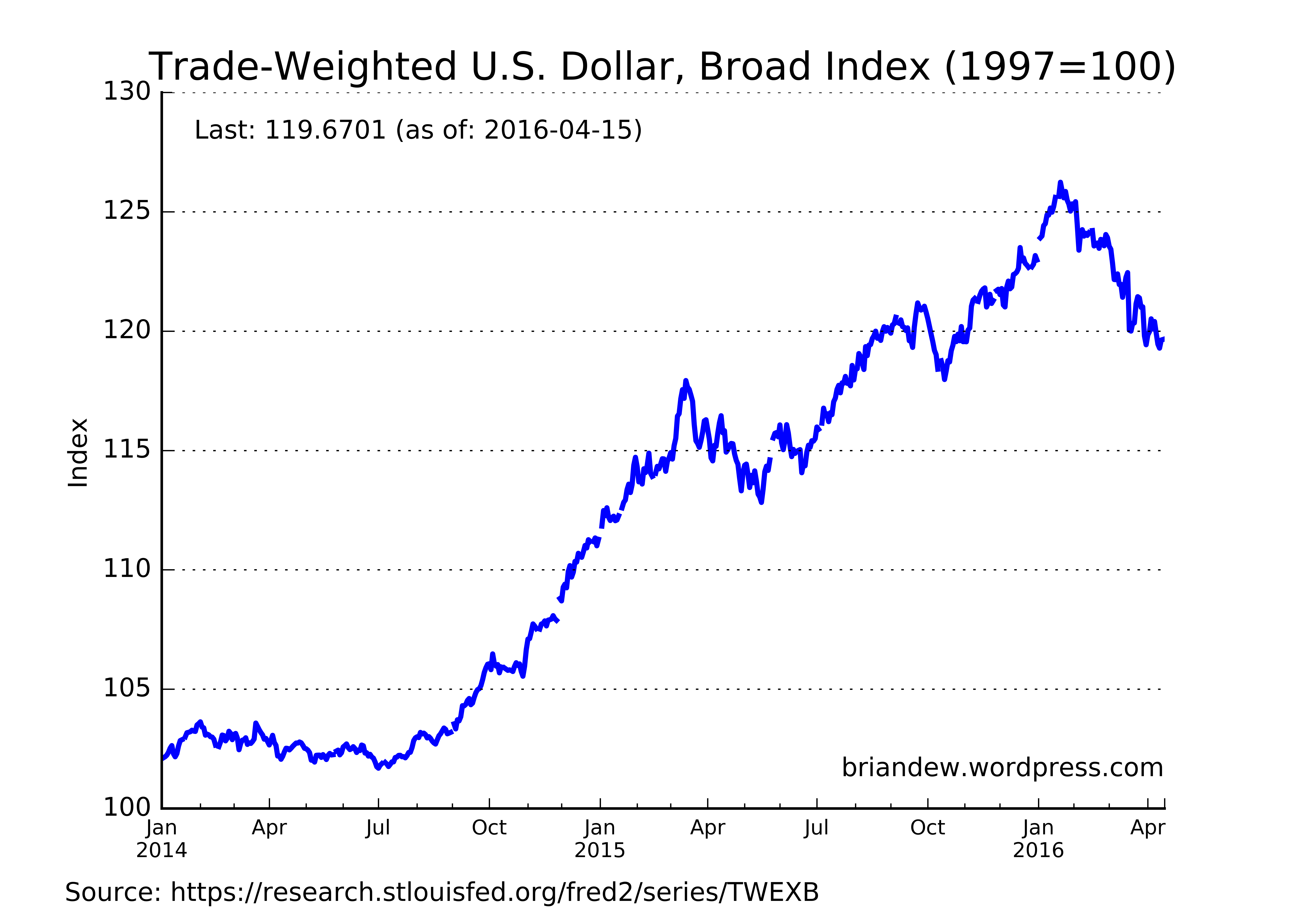 The broad index hit a five-month low on April 12.