Labor MarketPolicy
State Family Leave Systems and Labor Force Participation
The US infamously lacks a national family leave system. These systems are a form of social insurance, offering temporary income replacement to families when they welcome a new child.
In the absence of a nationwide policy, various states have developed their own family leave systems. As of 2022, seven states (California, New Jersey, Rhode Island, New York, Washington, Massachusetts, and Connecticut) and the District of Columbia (DC) provide family leave benefits. Employers in other states can still voluntarily offer family leave as a job benefit, but lack a statewide system or mandate.
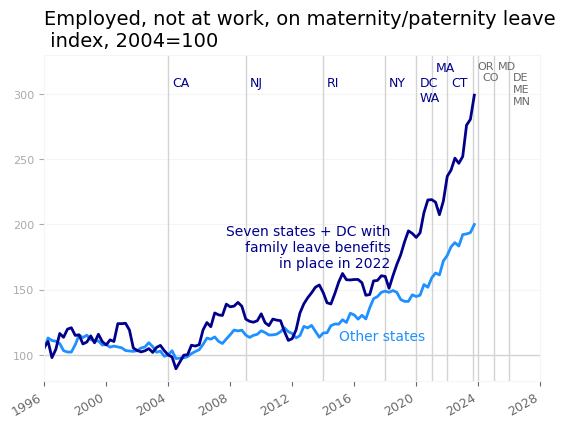
Since 2004, there has been a large increase in the rate that families with infants report being on maternity or paternity leave (see first chart). In states with such benefits, usage among families with infants has tripled. In other states, it has doubled. Families with infants are far more likely to remain connected to a job than in the past, particularly in states with systems for handling this process.
One of the many benefits of family leave is that new parents maintain their connection to a job. Family leave removes the need for some new parents to drop out of the labor force. For a real-world example, consider how women’s labor force participation differs between states with and without family leave policies.
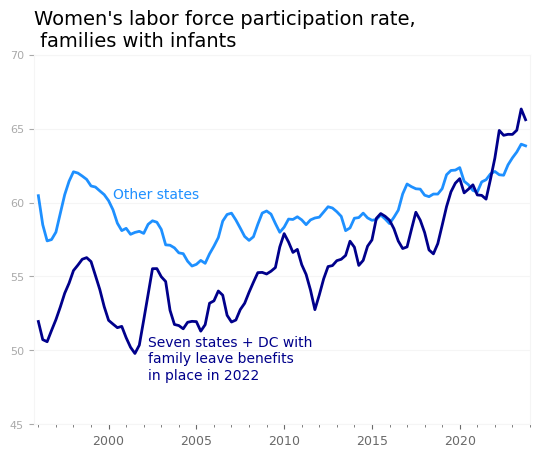
In the eight jurisdictions that have family leave in 2022, labor force participation among women age 18 to 54 in families with infants averages around 52 percent during the 1990s and early 2000s. This is about seven percentage points below the other states and following roughly the same trend.
As more states adopt family leave laws (annotations on previous chart), we see a notable increase in women’s participation in the labor force in these states, deviating from the previously stagnant trend. By 2022, participation is higher in states with family leave, surpassing 65 percent.
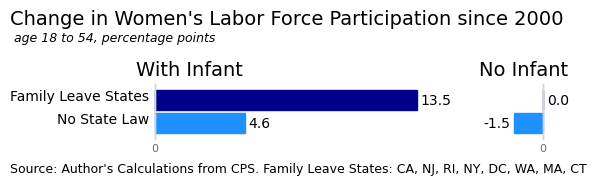
The extent of this reversal is impressive. Since the hot labor market of 1999 and 2000, the labor force participation rate among women with infants has increased by 13.5 percentage points, representing nearly 1 in 7 women, in states with family leave laws (see chart below).
As seen in the first chart, family leave rates also increased in states without these policies, boosting labor force participation among women with infants in those states, though to a lesser degree. Some of this effect may be due to measurement issues. For example, labor force participation is based on household address, not the state of the employer. That is, someone could live in a state without a family leave system but work for an employer that is based in California, New York, or DC.
It’s worth noting that while labor force participation was unchanged since 2000 for women without infants in states with family leave, the rate fell in states without family leave. Additionally, many women in states that currently have family leave laws had children before the laws were implemented. It will take time to see the full effect of these policies.
States with family leave laws are seeing positive results from these policies. Families have more time to care for their new child, less stress, and more stable income. And as the data show, parents are less likely to drop out of the labor force, which benefits both employees and employers. Over the next five years, more states will add these benefits and tap into the competitive advantage of having a useful system for handling a major life event. A short-term challenge doesn’t need to cause a long-term exit from the labor force. Many countries have solved this problem and at least some states have, as well.