Labor MarketPolicy
Disability and the Labor Market
Given the relatively tight labor market, individuals with disabilities have been finding work more easily than in the past. However, in a climate of debt committees and Medicaid cuts, efforts to further cut SSDI rolls need to be resisted, as the tight labor market will not last forever. Further, underneath the otherwise positive trends is a concerning increase in disability rates among young people.
Background
While the number of people receiving old age benefits from Social Security has risen steadily, the number of Social Security Disability Insurance (SSDI) beneficiaries follows a more-complicated pattern. As one example, disability rolls climbed until 1978 and started falling in 1979 as economic conditions improved. In the early 1980s, the Reagan administration tried to accelerate the decrease and aggressively cut off many people from disability benefits. This did a lot of harm. Blue states pushed back, and much of it was reversed in courts; however, nearly a million people stopped receiving benefits.
After the recessions of the early 1980s, disability rolls started to increase again. The number of SSDI beneficiaries peaked at nearly 11 million in 2013. The economy in 2013 was in bad shape. A common story at the time was that many SSDI beneficiaries lost jobs in the manufacturing and construction industry collapse, ran out of unemployment benefits, and qualified for disability anyway, because of the toll their jobs had taken on them. From 1979 to 2013 the drop in manufacturing and construction employment is equivalent to 5 percent of the entire US population.
Interestingly, the number of SSDI beneficiaries starts to fall in 2014, and has fallen steadily since. As of 2022, there are about 8.8 million beneficiaries, a total decrease of 20 percent from the peak. It is not immediately clear why the number of beneficiaries fell. There are a number of arguments on this topic:
- One argument is that the labor market improved for workers. Among other benefits, a tighter labor market means businesses are more likely to accommodate persons with disabilities and less likely to discriminate in hiring.
- A second argument is demographic. Each year, a portion of people who receive SSDI benefits hit the federal retirement age and move over to old age benefits. Perhaps this portion was larger than usual.
- Another argument is that efforts in the 2010s to cut the Social Security Administration have hampered people’s ability to get benefits.
- And an additional argument is that disability incidence rates are falling.
Each argument has different policy implications. And while efforts from the right to cut off benefits for persons with disabilities never go away, these efforts have also been bubbling more than normal, recently. As such, it is worth looking at trends around disability and the labor market.
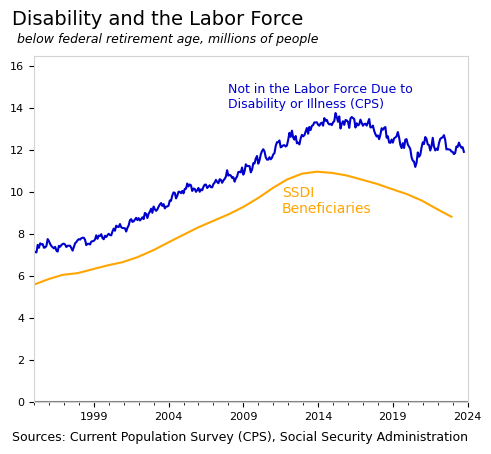
The chart above shows SSDI beneficiaries alongside a proxy from Current Population Survey microdata. The proxy shows individuals who are not in the labor force due to disability or illness. Specifically, they are neither employed nor actively seeking employment, and cite disability or illness as the reason. The proxy group is larger than the number of actual SSDI beneficiaries; individuals in the proxy group do not necessarily receive any disability benefits and in some cases are temporarily disabled or ill. The CPS proxy group tops out at over 13 million at around the same time as the peak in SSDI beneficiaries, and has fallen, though less rapidly, to under 12 million in October 2023. We can use the CPS proxy to examine demographic effects and labor market effects.
Demographic Effects
Since the population is rising and demographics are changing, we can get a better sense of trends by looking at the rate at which people report being out of the labor force due to disability or illness. We can also factor in demographic shifts, such as the aging of the population and the larger birth cohort after World War II.
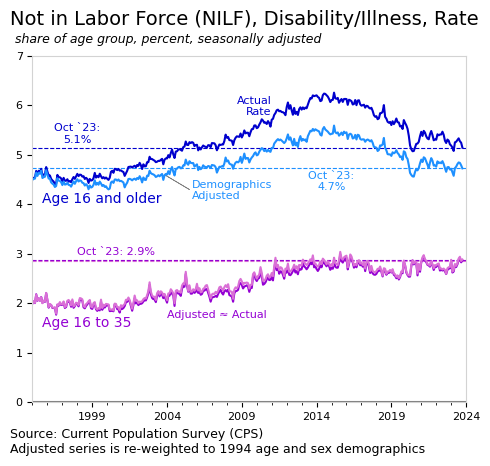
The rate at which people age 16 and older report being out of the labor force due to disability has returned to its mid-2000s level, from its high in 2015 (see chart above). The demographically-adjusted rate has fallen even further, nearly returning to its 1990s level. This development is encouraging.
Unfortunately, the same pattern is not found among those age 16 to 35, and changes in age demographics do not play a role for the younger group. An additional one percent of the age 16 to 35 group is out of the labor force and the trend in recent data is not encouraging. The diverging trend for the younger group raises a question about whether the overall effect is demographic or from the improved labor market. Did people simply hit retirement age or did the improved labor market play a role?
Labor Market Effects
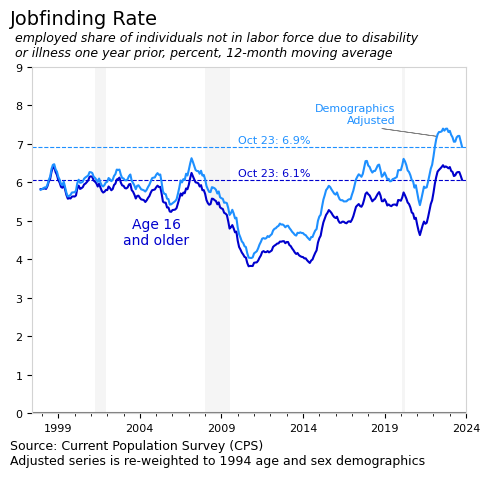
To answer the “demographics versus tight labor market” question, we can look at the jobfinding rate for people who are out of the labor force due to disability or illness. If a tight labor market is making it easier to enter to the workforce, it will be reflected in the jobfinding rate. In this context, the jobfinding rate is the share of individuals who have a job one year after being out of the labor force for disability reasons.
Indeed, the age 16 and older jobfinding rate improved substantially since 2019 (see next chart). Further, adjusted for demographics, the jobfinding rate is far above its 1990s and 2000s rate. Importantly, this confirms that the tight labor market is helping people to find jobs and driving down the rate at which people are out of the labor force for disability or illness.
To further gauge the labor market effect, we can look at employment rates for persons with disabilities. Since 2008, the CPS has included direct questions about disability, which can be used to calculate these rates (also reported by BLS, here).
While employment rates for persons with disabilities are far lower than for the general population, these rates are currently well above their pre-pandemic levels (see next chart). Since 2013, the employment rate for people age 16 to 35 with at least one disability has improved by more than 15 percentage points.
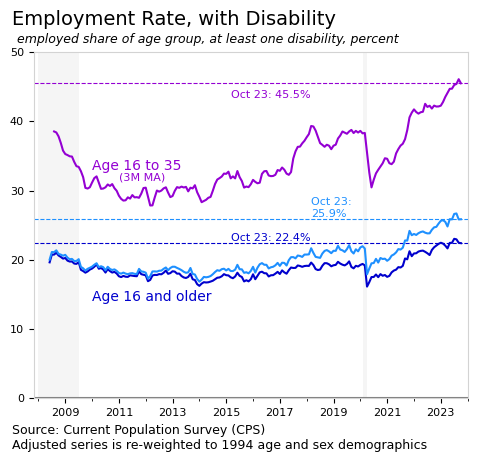
The labor market effect is evident. The improvement in jobfinding and employment rates are encouraging. The increase in employment rates for the younger group is a particularly large change, and is at odds with the finding that a higher percentage of young people are currently out of the labor force due to disability or illness than in 2013. For both to be true, the rate of disability must have increased substantially for young people but not for older people. And indeed, to my surprise, this is exactly what the data show.
Growing Disability Rate Among Young People
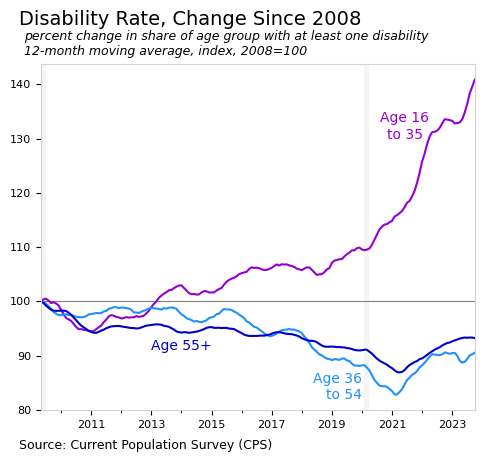
Since 2013, the age 16 to 35 disability rate surged by 40 percent, equal to nearly 2 percent of the age group. While labor market conditions for young people with disabilities have improved, far more young people report disabilities. Meanwhile, disability rates for older groups decreased 10 percent since the great recession. My search for coverage of this interesting result, which is mostly a development since 2019, did not come up with anything.
The Need for Income Support Is Not Going Away
Combining these dynamics, I worry that conflicting signals could lead to harm, echoing the challenges of the early 1980s. Over the past year, almost 12 million people have been kicked off Medicaid, mostly for procedural issues. There is a view that benefits expanded during the pandemic were good but were temporary. While the economy has improved, the need for the services that were expanded during the pandemic has not diminished. Reducing these services causes real pain. Likewise, the labor market conditions have improved for individuals with disabilities but the needs are also evolving and labor markets can change very rapidly.
Against this backdrop, challenging misconceptions about SSDI and labor market dynamics is crucial. The decrease in SSDI beneficiaries since 2013 is part of a more complicated reality that involves demographic effects, labor market effects, diverging disability rates between segments of the population, and policy decisions about how we provide support to people. Policy discussions should consider these complexities. Indeed, in the case of disability and young people, the need for support is greater than ever, despite the strong labor market. And strong labor markets do not last forever.
It’s imperative, therefore, that policy discussions and support systems adapt to these evolving challenges, ensuring that those with disabilities receive the necessary support irrespective of labor market conditions.