Labor Market
It Was the Economy, Not the Generation
Employment data from the Current Population Survey spanning 1962-2025 show that Millennials and Gen Z work at the same rates as previous generations. The “lazy Millennial” narrative was a misattribution of cyclical economic conditions to generational character.
How the Great Recession created a false narrative
A decade ago, the shadow of the Great Recession had darkened the US economy for so long that people began to speculate whether weaker economic conditions were permanent. A narrative around the “lazy millennial” had become quite common. According to this narrative, perhaps the cause of lower employment rates among young people wasn’t the economy; perhaps the youngest generation was simply flawed.
Jean Twenge, who termed Millennials the “me me me generation”, argued at the time that the core issue was Millennial entitlement. Millennials wanted the same lifestyle as previous generations, but lacked the work ethic required to obtain it.
Only a few years after many had given up hope, the economy finally began to recover. By 2019, employment rates were returning to the high levels seen during the late 1990s. In 2020, the pandemic hit, but the economic impact was relatively short-lived, compared to the Great Recession, thanks to a much larger economic stimulus during the COVID recession.
Currently, demographically-adjusted employment rates are near all-time highs. As it turns out, Millennials and Gen Z are working just as much as previous generations. And Millennial and Gen Z women are working far more than their grandmothers and great grandmothers.
Using the Current Population Survey, it is possible to compare employment rates across generations (see chart 1). For men aged 25 to 54, employment rates have been relatively stable over time, with some minor fluctuations stemming mostly from economic conditions. For women in this age group, employment rates continue to climb across generations; Millennial and Gen Z women are working more than previous generations.
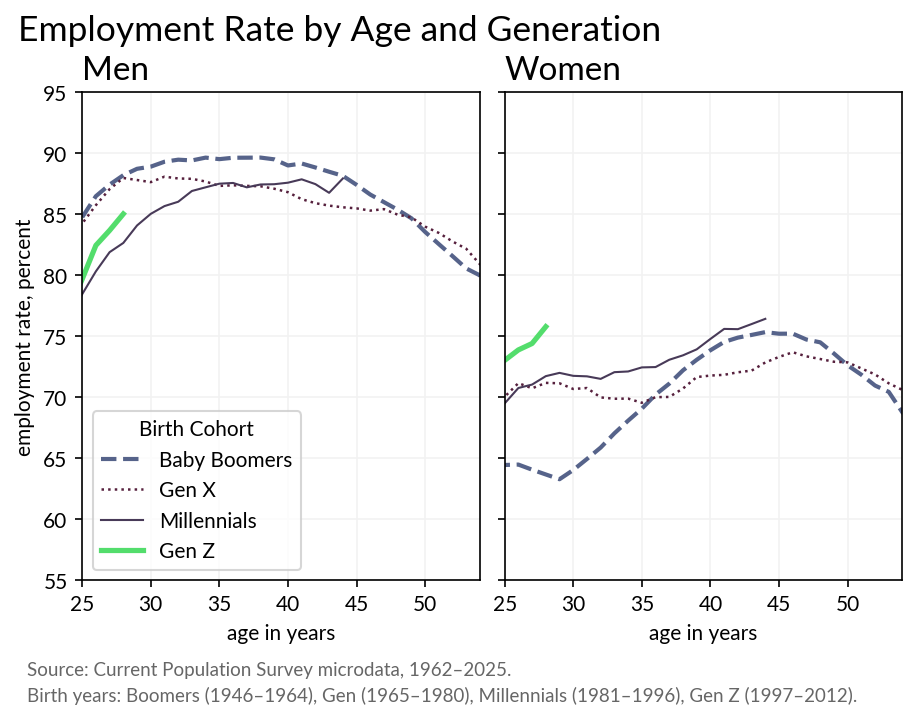
At age 35, Millennial women have a 72 percent employment rate, compared to just 55 percent for Silent Generation women at the same age—a 17 percentage point increase across three generations. By their early 40s, Millennial men have reached an 88 percent employment rate, matching Baby Boomers at the same age.
Economic conditions are cyclical and we all live downstream of labor market conditions. When people compare labor market outcomes across generations, they end up comparing the economic conditions faced at a given age, across time, whether they realize this is what they are doing, or not.
We can see the impact economic conditions have on generations by looking at how the Great Recession, and its long shadow, affected men’s employment (see chart 2). Because the Great Recession was caused by a housing bubble, it resulted in an enormous reduction in construction employment, and disproportionately affected men, and younger men in particular.
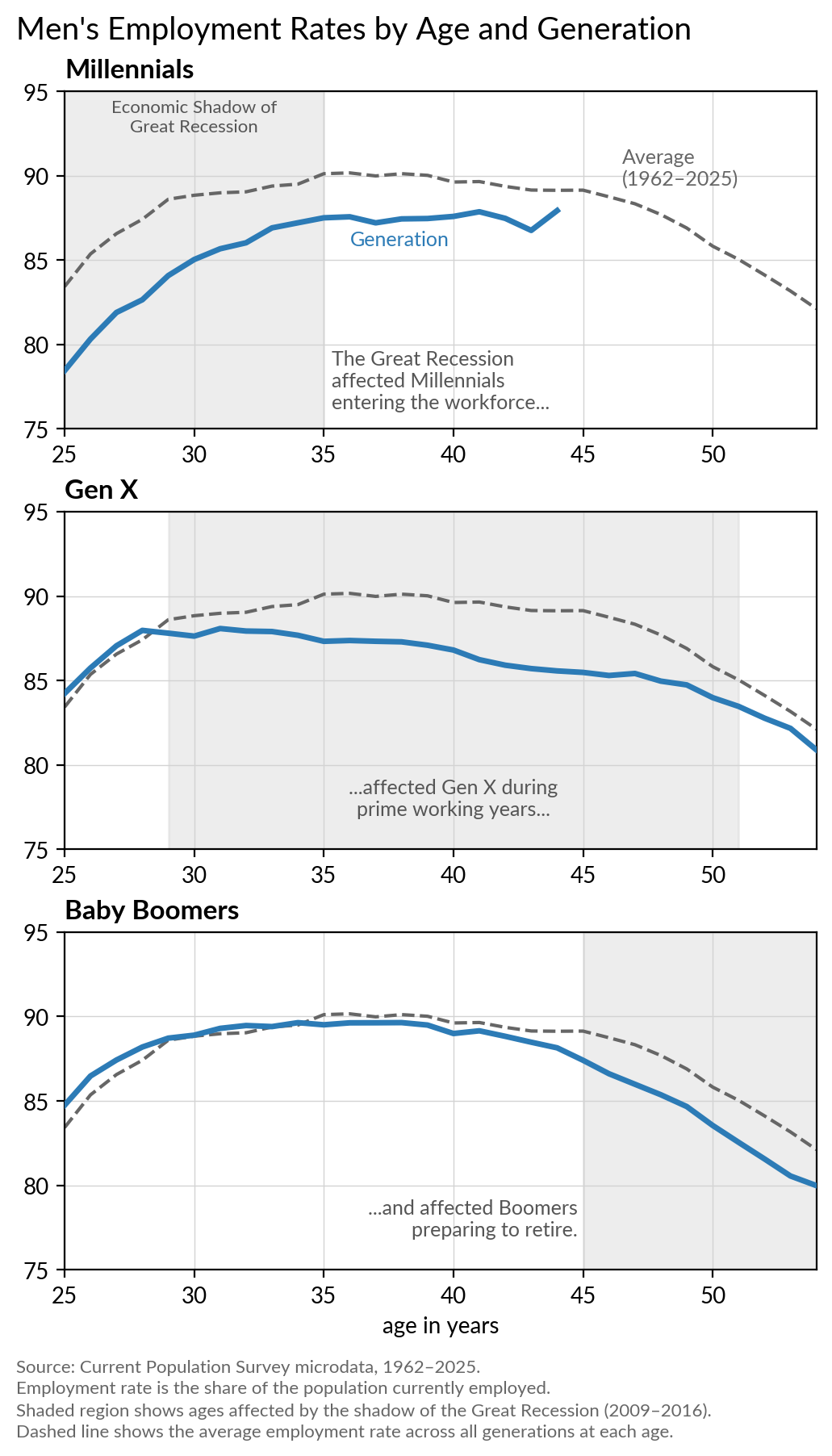
Millennials were hit by the Great Recession while entering the workforce, while Gen X was hit during prime age, and Boomers were hit while preparing to retire. These effects are seen by comparing the average employment rate for men with the rate for each generation. Employment fell substantially for each generation during the shadow of the Great Recession. At age 25, Millennial men had a 78 percent employment rate—6 percentage points below Baby Boomers at the same age—reflecting the lingering effects of entering the workforce during the Great Recession.
Men in the Baby Boomer generation worked less than previous generations, during their late 40s and 50s, while they were hit by the Great Recession. Yet a “lazy Boomer” narrative did not seem to emerge during this time.
The Bigger Picture
Instead of assuming that the current economic data reflect the personal characteristics of the individuals in the economy, it’s safer to assume that the current economic data reflect the current economic conditions.
If we take a zoomed out view of employment across generations, we see that the same basic pattern of employment by age has existed for at least 70 years (see chart 3). The bigger picture pattern shows the vast majority of young people enter the workforce at some point between age 16 and 25. During prime working ages, for example age 25 to 54, employment rates are high, though around 20 percent of the population is not employed at a given point in time, in any generation, due to unemployment, disability, caregiving responsibilities, school, or other reasons. Later in life, as workers retire, employment rates fall again.
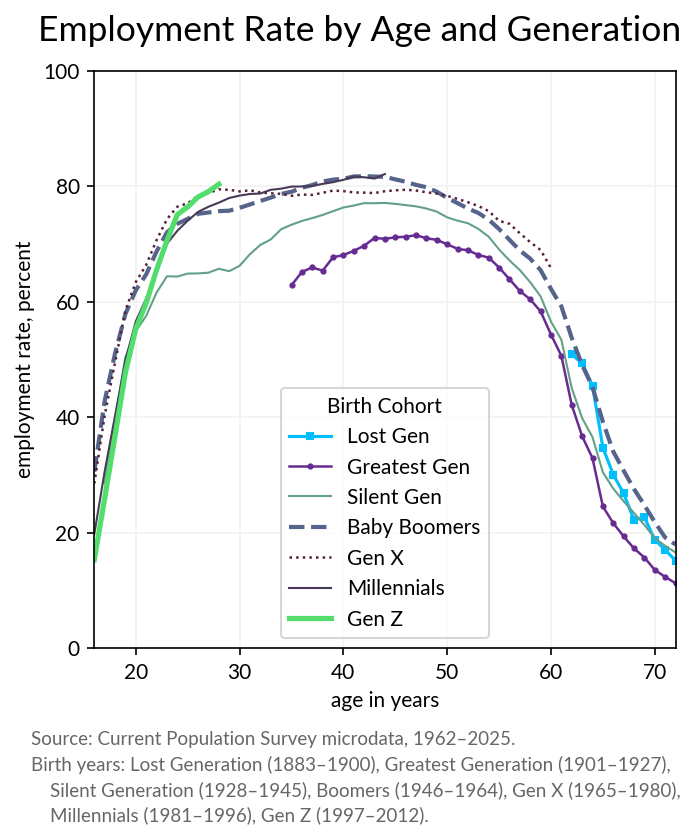
Despite the enormous impact on society from the Great Recession and its long shadow, the effect from the Great Recession on these data is relatively muted, when compared the much larger pattern that exists across all generations. Indeed, even major structural changes in these data over the past 70 years, such as women entering the workforce and increased education, are small compared to the consistent larger pattern.
Hindsight shows us that the “lazy Millennial” myth was ultimately a misinterpretation of the data. What looked like generational decline was actually the predictable impact of a severe recession on workers entering the job market at the wrong time. As the economy recovered, so did employment rates across all generations—because it was always the economy, not the generation.
Data Sources
- Current Population Survey (CPS) – U.S. Census Bureau and Bureau of Labor Statistics
- EPI Current Population Survey Extracts – Economic Policy Institute
- IPUMS CPS – Integrated Public Use Microdata Series