Housing & DemographicsLabor Market
53 Percent of Young Adults Live with Their Parents
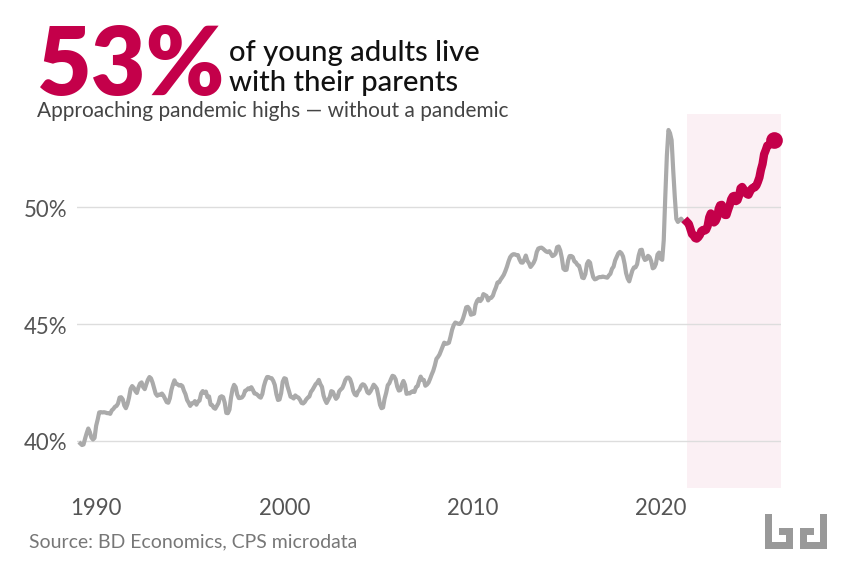
As of January 2026, 52.9 percent of Americans age 18 to 29 are living with a parent, grandparent, or other relative. That is within half a percentage point of the 53.3 percent peak hit during the COVID lockdowns in mid-2020, when colleges sent students home overnight and the economy shut down. This time, there is no pandemic.
The rate never fully came back down after COVID. It fell through late 2021, then started climbing again and has not stopped. What was an emergency in 2020 has quietly become normal.
The easy assumption is that these are unemployed twenty-somethings. They are not. Among young adults living with family, 56 percent are employed. That is 15.6 million people with jobs who live with their parents. The median employed young adult living at home earns about $34,000 a year. The median for those living independently earns $48,000. That $14,000 gap goes a long way toward explaining why so many stay.
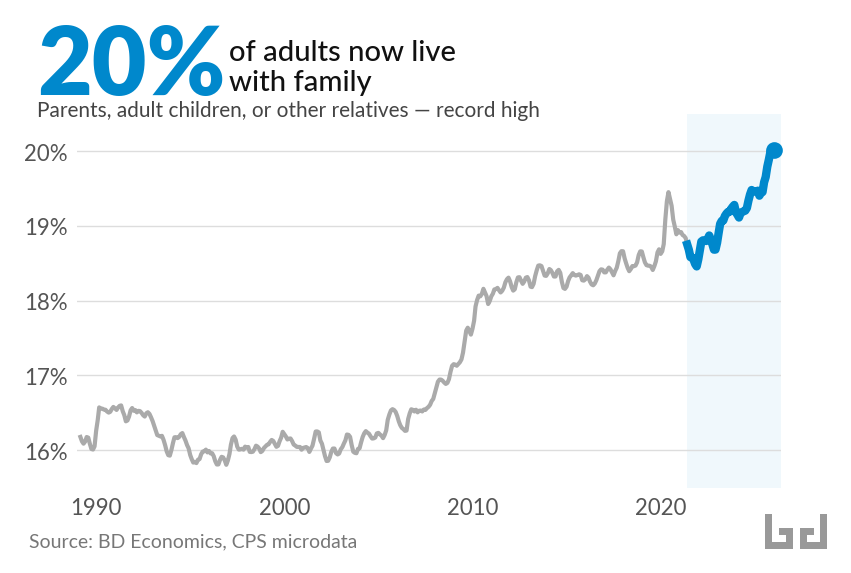
And it is not just young people. One in five adults of all ages now live with family, the highest rate in nearly four decades of data. Since 2019, roughly 7 million additional adults have moved in with relatives or never moved out. Two million of those are age 30 to 44.
The numbers come from the Current Population Survey, a monthly survey of about 60,000 households conducted by the Census Bureau. I identify family living arrangements using the household relationship variable in the CPS microdata and track the results in the BD Economics US Chartbook. The measure counts anyone living in the same household as a parent, adult child, grandparent, sibling, or other non-spouse relative. Values are seasonally adjusted and smoothed with a three-month moving average.
Federal Reserve economists documented the COVID-era spike. The NAHB flagged the 2024 uptick in annual data. What the monthly CPS data shows is that the trend did not pause. It accelerated.
The overall share of adults living with family has gone from 16 percent in the mid-1990s to 18 percent after the Great Recession to 20 percent today. Each step up was supposed to be temporary. None of them reversed.

