PolicyPrices & Inflation
The Wrong Gift
Two Democratic senators recently introduced competing proposals to cut taxes for working Americans. Sen. Van Hollen’s Working Americans’ Tax Cut Act would eliminate federal income taxes for individuals earning under $46,000 and couples under $92,000. Sen. Booker’s Keep Your Pay Act goes further, making the first $75,000 in household income tax-free. Both offset part of the cost with higher taxes on the wealthy.
Mike Konczal has described how Democrats arrived here. Bush’s 2001 tax cuts came with expiration dates. When the deadline hit in 2010, Obama — boxed in by a no-tax pledge and 9.8 percent unemployment — extended them. What began as a Republican tax policy became a bipartisan commitment. Eric Levitz pointed out the arithmetic: both senators officially support universal childcare, paid leave, and expanded healthcare. Taxing billionaires cannot fund that agenda and trillions in new tax cuts.
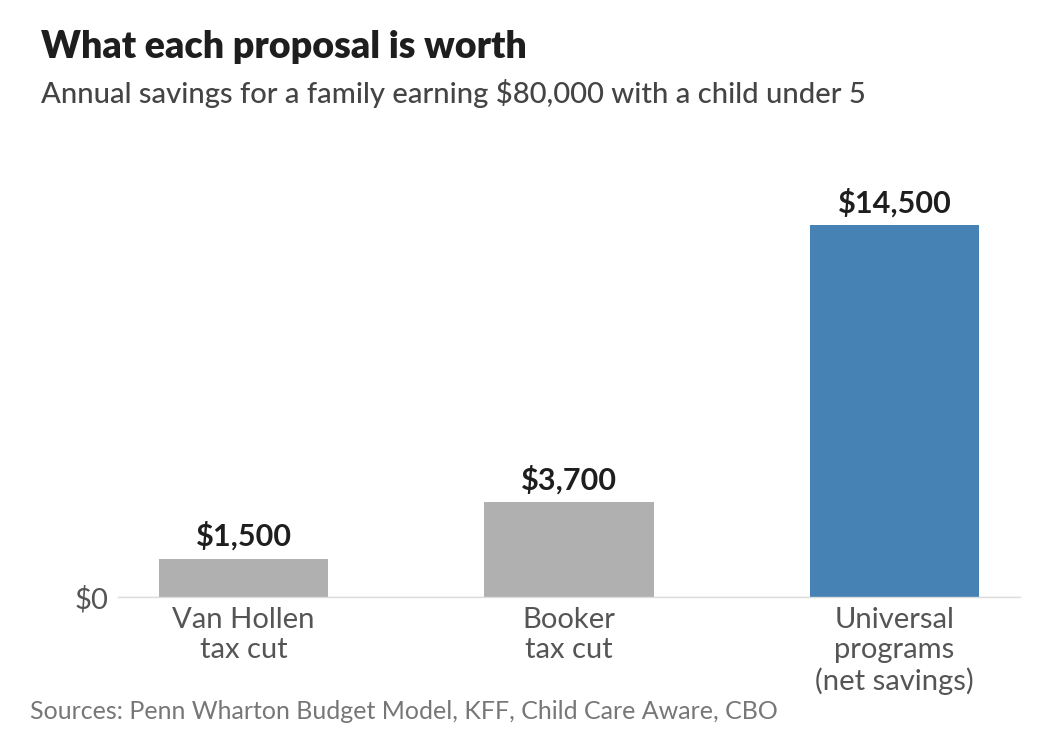
The deeper issue, though, goes beyond fiscal math. It’s what the tax cuts are actually worth. According to the Penn Wharton Budget Model, a family earning $80,000 saves about $1,500 a year under Van Hollen’s plan and roughly $3,700 under Booker’s.
What families are already paying
That same family, with employer-sponsored health insurance, pays on average $6,850 per year in premiums for family coverage. Add deductibles and out-of-pocket costs and the total runs $9,000 to $12,000.
If they have a child under five in center-based care, they face an average annual cost of $13,128. And if a parent needs time off for a new child or a family illness, no federal paid leave program exists.
These costs are unavoidable. They are the private price of services that other wealthy countries fund through the tax system. For a middle-income family with a young child, they add up to $20,000 to $25,000 per year.
And yet the United States spends more on these things than other countries, not less. Families just pay out of pocket instead of through taxes.
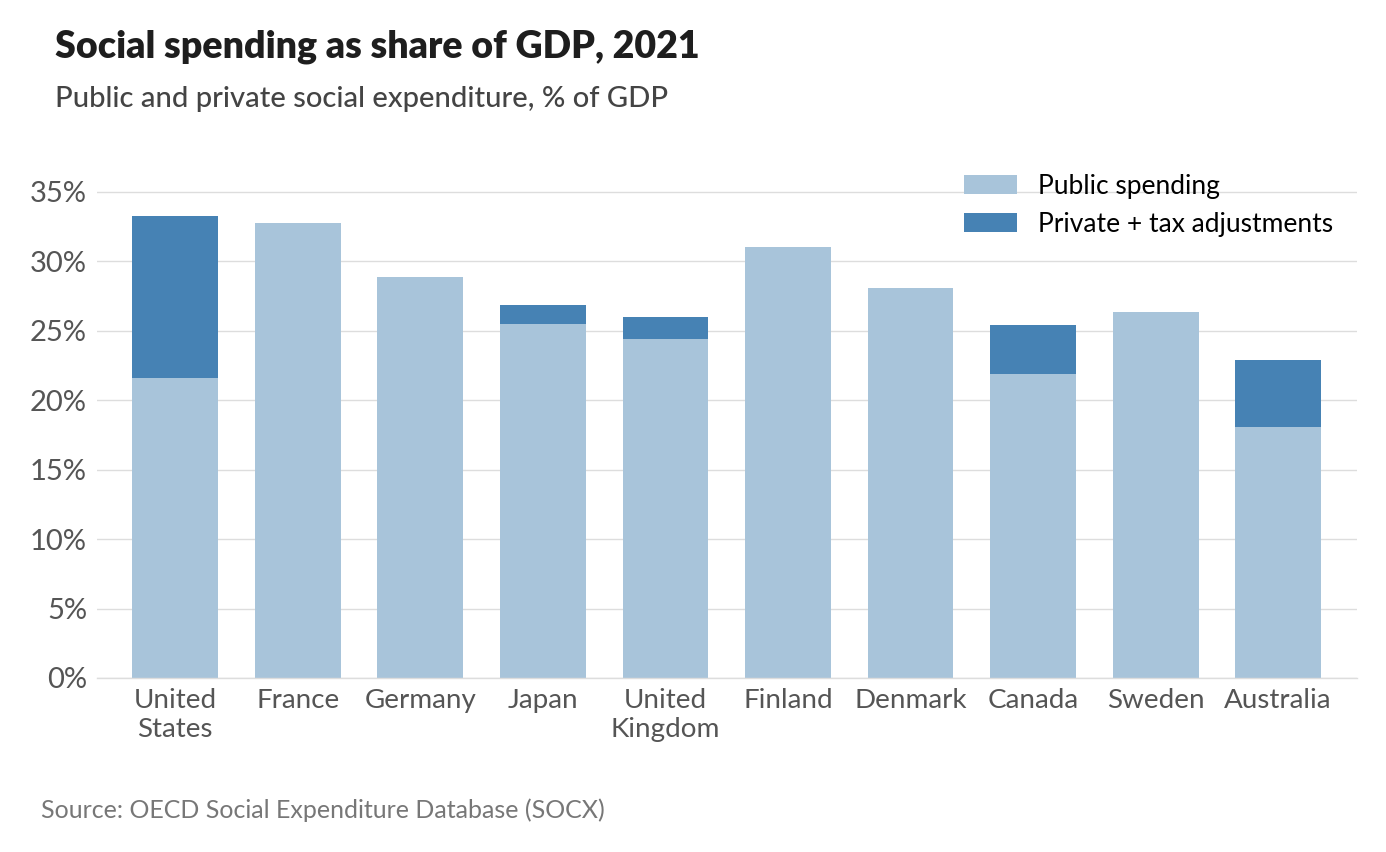
Among wealthy democracies, the U.S. ranks first in total social spending as a share of GDP. Most of that spending is private — employer health premiums, daycare tuition, out-of-pocket costs. In France, Germany, or Denmark, the same needs are covered publicly. The total cost to society is similar. The difference is who gets the bill.
The alternative
What would it cost this family to fund these services through the tax system instead?
Healthcare. Under Sen. Sanders’ Medicare for All financing, a 4 percent tax on earnings above $29,000 would cost this family about $2,040 per year. Current premiums and out-of-pocket costs — $9,000 to $12,000 — would be eliminated.
Childcare. The Child Care for Working Families Act would cap costs at 7 percent of family income — a maximum of $5,600, saving about $7,500 compared to the current average. No new household-level tax.
Paid leave. The FAMILY Act would create a social insurance program funded by a 0.4 percent payroll tax split between employer and employee. The worker’s share at $80,000: $160 per year, for 12 weeks of paid leave at 66 percent of wages.
| Costs eliminated | New taxes | Net | |
|---|---|---|---|
| Healthcare | $9,000–$12,000 | $2,040 | +$7,000–$10,000 |
| Childcare (1 child <5) | ~$7,500 | $0 | +$7,500 |
| Paid leave | — | $160 | 12 weeks coverage |
| Total | ~$16,500–$19,500 | ~$2,200 | ~$14,500–$17,500 |
The new taxes total about $42 a week. The private costs they replace total $350 to $400.
There is another gap. The tax cuts leave out the poorest twenty percent of families, who already owe no federal income tax. Universal programs cover them by design. And because middle-class families use the same programs, they stay funded.
Why it matters how you pay
The reason matters. Healthcare and childcare are services where private markets fail. Kenneth Arrow established in 1963 that patients cannot evaluate their own care the way they shop for other goods — competitive pricing breaks down. Janet Yellen, as Treasury Secretary, called childcare “a textbook example of a broken market”: unaffordable for parents, underpaying for caregivers, undersupplied for communities.
These are old findings. The reason nothing has changed has little to do with affordability. When you add up what American families already pay in health premiums, daycare, and out-of-pocket costs, they pay comparable rates to Danish or Swedish workers. The difference is that Danish workers get healthcare, childcare, and paid leave in return.
So the question is what to do about it. A tax cut sends families back into the same broken market with the same prices. A program replaces the market. And when government helps families through programs, families know it. When government helps through tax cuts, they don’t. The difference matters: a benefit people can see is a benefit people will fight to keep.
Democrats have spent twenty-five years promising middle-class families they won’t have to pay more in taxes. During that time, private costs for healthcare and childcare have risen relentlessly. By competing on tax cuts, Democrats concede that government has nothing to offer these families. The table above says otherwise.